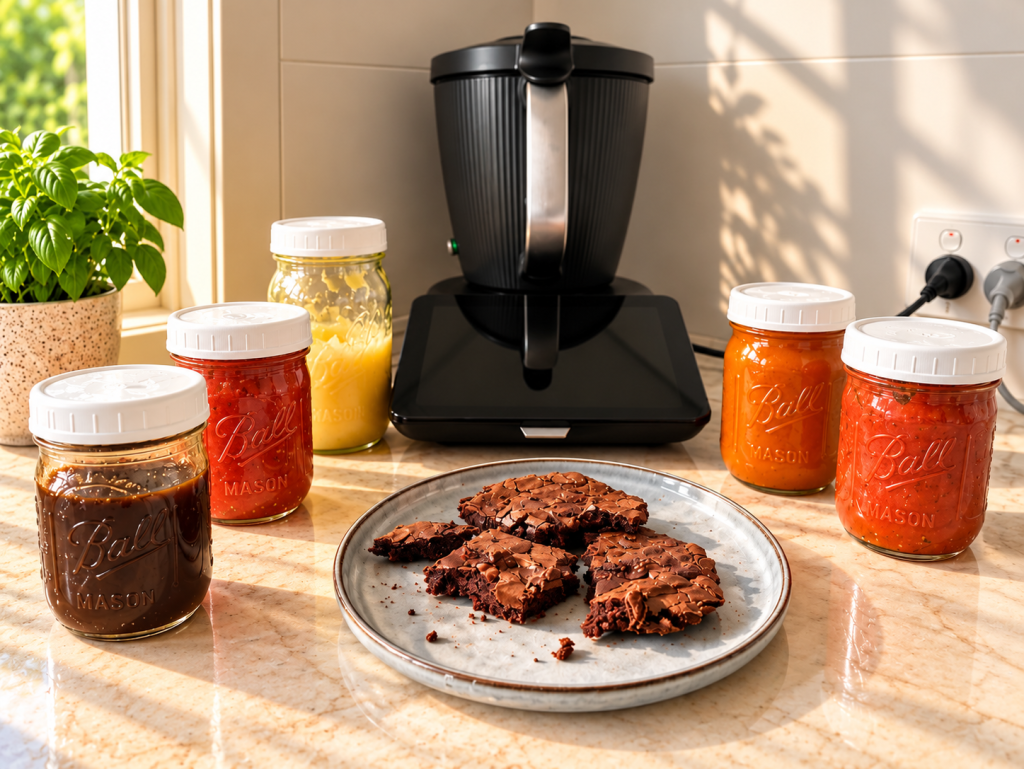
Have you ever turned over a packet in the supermarket, scanned the ingredient list and wondered when breakfast became a chemistry lesson?
I have, and lately I have been paying much more attention to what is actually in the food we eat. Not because I believe every packaged product is bad, and certainly not because I am about to churn butter at sunrise, grow every vegetable we eat and ban anything that comes in a wrapper. Real life is far messier than that. I work full time, our weeks are busy and convenience will always have a place in my kitchen.
For me, this is less about chasing a picture-perfect diet and more about shifting the balance: a little less food manufactured in a factory, a little more food made in my kitchen, a little less mystery and a little more knowing.
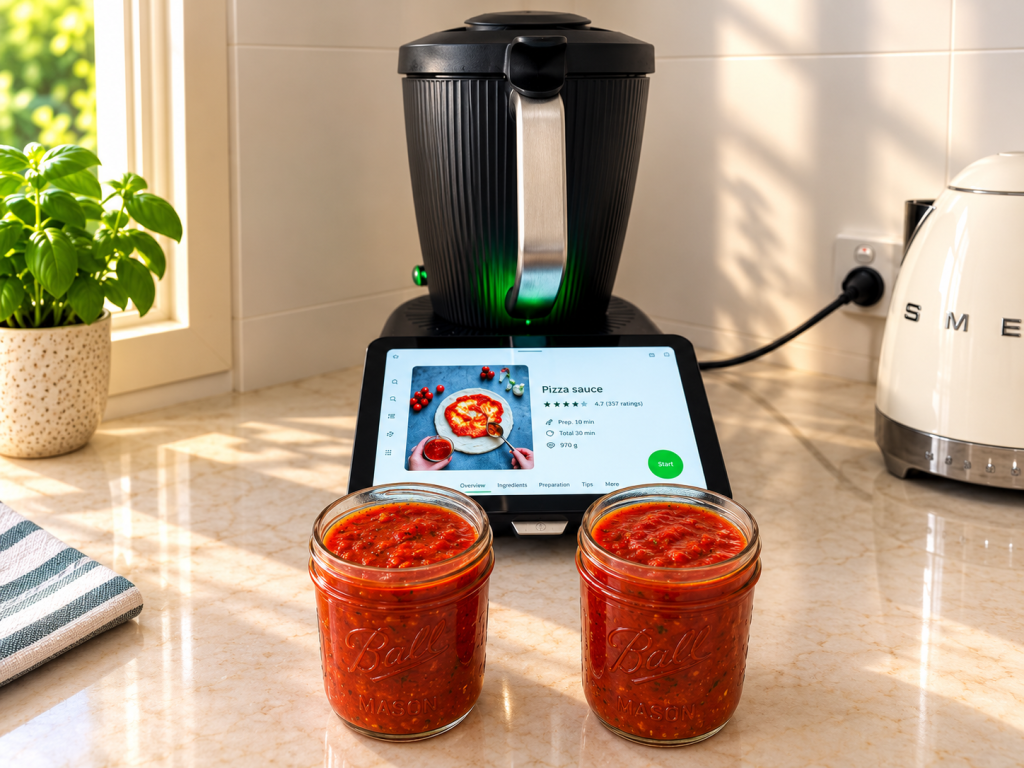
The more I use my Thermomix®, the more often I find myself asking one deceptively simple question: could I make this myself?
Quite often, the answer is yes.
I’m not chasing perfection
Before this starts sounding like a declaration of war on the supermarket aisle, it isn’t.
I still buy packaged food. I still use shortcuts. There are still evenings when convenience wins by a country mile because life has galloped ahead and dinner is struggling to keep up.
What I am trying to do is become more conscious of the difference between food that is simply convenient and food that has been processed so extensively that the original ingredients seem to have disappeared somewhere along the production line.
That distinction matters to me because when I make something myself, I know exactly what went into it. I decide how much sugar to add, how much salt to use, whether I want more garlic, fewer sweeteners, extra vegetables or no preservative at all because I know we will eat it quickly.
It gives me something I increasingly value in the kitchen: control.
What exactly are ultra-processed foods?
The phrase ultra-processed food, or UPF, seems to be everywhere at the moment, but it can sound more mysterious than it really is.
Ultra-processed foods are generally industrially formulated products made through multiple processing steps, often using refined ingredients and additives. The World Health Organization notes that healthy diets are generally based around a variety of minimally processed and unprocessed foods, while diets containing significant amounts of highly processed foods are associated with poorer health outcomes.
That does not mean processing itself is the villain of the story. Frozen vegetables are processed. Milk is processed. Tinned tomatoes are processed. Cooking itself is a form of processing.
The issue is not whether food has been processed at all, but how far it has travelled from its original form and what the overall dietary pattern looks like.
Many ultra-processed foods are designed to be intensely palatable, convenient and easy to eat. They can also be high in energy, salt, free sugars or unhealthy fats while offering less nutritional value than meals built around whole or minimally processed ingredients.
That is what has made me stop and think.
Not panic. Not purge the pantry. Just think.
Breakfast was one of the first places I started looking
Busy mornings are fertile ground for convenience.
Grab something, drink something, find the keys, feed the dog, realise you have forgotten something, go back inside, leave again.
Breakfast products such as UP&GO exist because they solve a real problem: they are quick.
I completely understand the appeal.
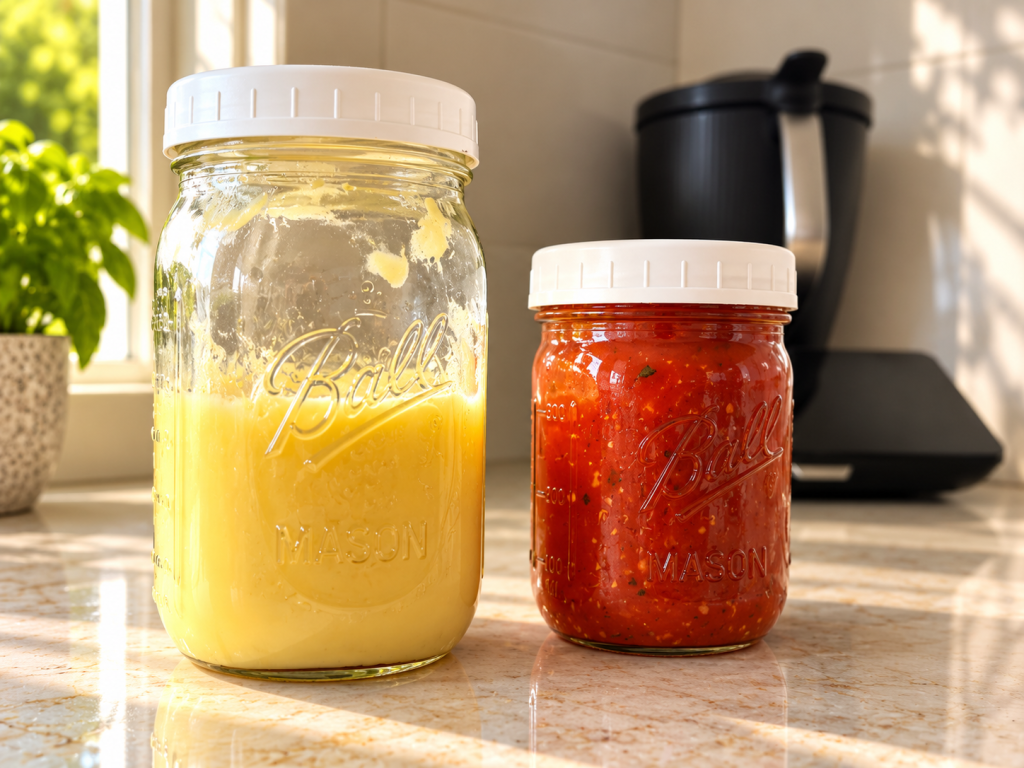
But instead of automatically reaching for a ready-made breakfast drink, I have started asking whether there is a simple Thermomix® alternative that gives me the same convenience with ingredients I have chosen myself.
Cookidoo® has a Grab and Go Breakfast Drink using milk, water, eggs, sweetener and vanilla. It takes only about five minutes of active preparation, although it needs chilling time before serving.
That is the kind of swap that interests me.
It is not about declaring one drink virtuous and another villainous. Food does not need a halo or horns. It is about having options and being able to choose the one that suits us.
If I can make something ahead, pour it into the fridge and have breakfast ready to grab in the morning, I still get the convenience. The difference is that I know exactly what went into it.
Sauces and condiments are another eye-opener
Sauces have a remarkable ability to fly under the radar.
A squeeze of this, a spoonful of that, a dollop over dinner and suddenly several different bottles have joined the meal without us really thinking about them.
Turn those bottles around, though, and the ingredient lists can become more complicated.
Food additives are substances used for practical reasons such as preserving food, maintaining texture, improving stability, enhancing colour or adding sweetness. In Australia and New Zealand, additives must undergo safety assessment before they are approved for use.
So I do not think it is helpful to say that all additives are bad. They are not, and many serve useful purposes.
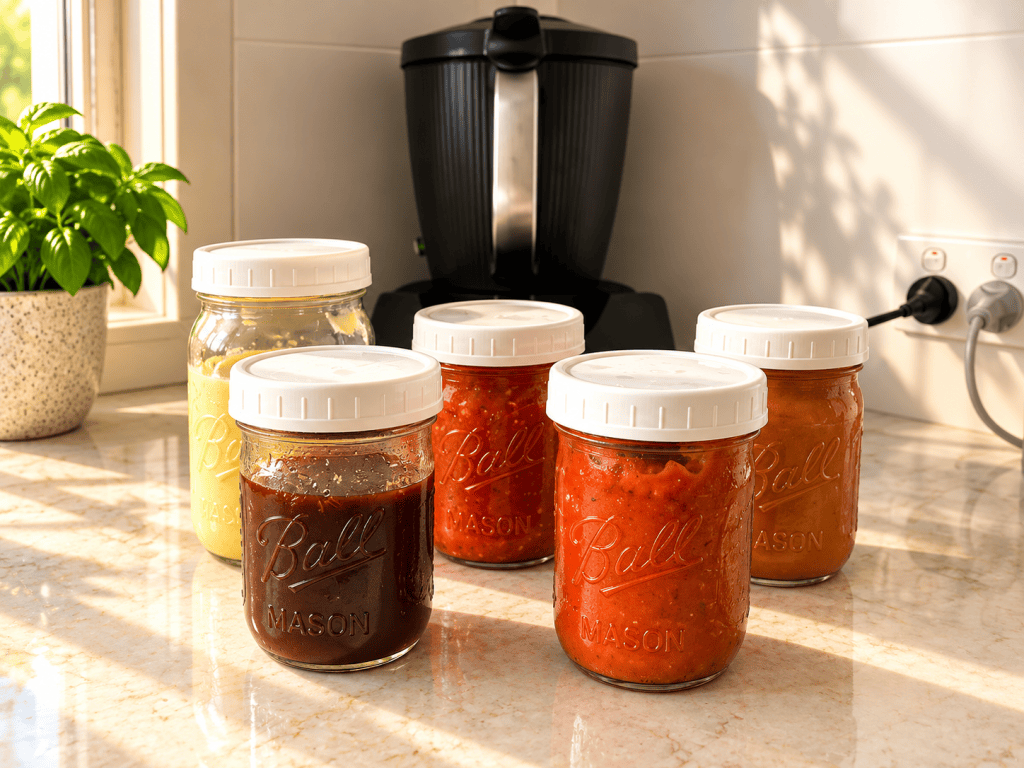
What interests me more is the fact that when I make a sauce myself, I can choose what goes into it.
If I want less salt, I use less. If I want less sugar, I adjust it. If I want more garlic, the answer is almost always yes. If I want a sauce built from tomatoes, herbs, onion and spices, I can make exactly that.
The supermarket bottle is a finished sentence. Homemade cooking gives me the pen.
The additive conversation needs balance
This is one of those topics where the internet can quickly turn a sensible conversation into a circus.
One headline tells us an ingredient is harmless. Another suggests it is responsible for everything short of the fall of the Roman Empire.
The truth is more nuanced.
Food additives used in Australia and New Zealand are assessed by Food Standards Australia New Zealand for safety at permitted levels, and many substances used as additives also occur naturally in foods.
Some people can also experience sensitivities to particular additives. FSANZ notes that reported reactions to some food colours can include symptoms such as rashes, headaches or behavioural changes in susceptible individuals, while also stating that approved colours are consumed at levels well within accepted safety limits in Australia.
For me, that is a useful reminder not to swing too far in either direction.
I do not need to fear every number on an ingredient label, but I also do not need to ignore the label entirely.
Awareness sits somewhere in the middle, and that is where I am trying to live.
My Thermomix® makes the choice easier
I have always technically been able to make sauces, dips, breads, dressings and other staples from scratch.
The Thermomix® did not arrive and suddenly teach humanity how to make mayonnaise.
What it changed for me was the effort equation.
If making something requires an hour, three saucepans, a blender, a chopping board and enough washing-up to test the strength of a marriage, I am far less likely to do it after work.
If the Thermomix® can weigh, chop, mix, heat and stir in the same bowl, suddenly the barrier becomes much smaller.
That matters because intentions are fragile things. We can have every intention of cooking from scratch, eating better and using up what we have, but when life gets busy those intentions can disappear faster than a packet of biscuits in a staffroom.
Convenience is powerful.
So rather than trying to fight convenience, I am trying to use it differently.
I want homemade food to be convenient too.
I can decide how much sugar goes in
Sugar is a perfect example of why I enjoy making more things myself.
When I buy a finished product, someone else has already written the recipe.
When I make it, I get to make the decisions.
I can reduce the sugar. I can use fruit for sweetness. I can change the flavour. I can taste, adjust, rethink.
The same applies to salt.
Of course, homemade does not automatically mean healthier. A homemade chocolate cake is still chocolate cake, and I have no intention of pretending that putting it through a Thermomix® somehow turns it into broccoli.
But at least I know what is in it.
That is the difference.
Scratch cooking has changed the way I look at my pantry
The more I make things myself, the more versatile my pantry seems to become.
Flour is no longer just flour. It is bread, pizza dough, rolls, pancakes and cakes.
Tomatoes can become sauce.
Herbs and vegetables can become stock paste.
Nuts can become nut butter.
Cream can become butter.
Basic ingredients stop looking boring and start looking full of possibilities.
The pantry becomes less of a storage cupboard and more of a toolbox, and my Thermomix® is often the tool that turns one ingredient into something completely different.
There is a quiet satisfaction in that.
This isn’t about being “good”
Food is never just fuel.
It is family, culture, celebration, comfort, memory and convenience. It is Sunday lunch and birthday cake and the emergency packet hiding at the back of the cupboard when the day has gone spectacularly off course.
I do not want healthy eating to become another stick we use to beat ourselves with.
That feels counterproductive.
Instead, I want to focus on awareness and intention.
I want more of our meals to begin with ingredients I recognise. I want to make more of our sauces, drinks, breads, dips and staples when it is practical. I want to know what is going into our food, while still leaving room for convenience when convenience is exactly what we need.
There is an irony in making healthy eating so complicated that it becomes impossible to maintain.
For me, simpler is better.
Small changes are still changes
Sometimes we imagine that healthier eating needs to arrive like a thunderclap: a new diet, a cleared pantry, a complete transformation beginning on Monday morning.
But lasting change is rarely that dramatic.
It is more often a quiet accumulation of small choices.
One homemade sauce. One breakfast swap. One loaf of bread. One dressing. One meal made from ingredients already sitting in the fridge.
A single change may look insignificant, but repetition gives it weight.
Habits grow slowly, almost invisibly, until one day the thing that once required effort simply feels normal.
That is what I am aiming for.
I am not trying to remove every processed food from our lives. I am simply trying to tip the balance towards more food made from ingredients I know and understand, more food prepared at home when it makes sense, and more curiosity about what we are eating.
Less perfection, more intention. Less mystery, more making.
And if my Thermomix® makes that easier, faster and more realistic in a busy household, then that is another reason it earns its place on my kitchen bench.
I’d love to know…
What is one supermarket staple you would love to start making yourself?
Is it tomato sauce, bread, yoghurt, dips, breakfast drinks, salad dressing or something completely different?
And if you already use your Thermomix® for homemade staples, what is the one thing you now make so regularly that you would hate to go back to buying?
I’d love to hear your favourites.
If you would like to see how the Thermomix® TM7 can make cooking from scratch easier, you are always welcome to message me through Gamble Creek Farm.
Want to know more about the Thermomix® TM7?
I’m Nicole, a Thermomix® consultant in Australia, and I’m always happy to answer questions, share ideas and help you discover more ways to use your Thermomix®.
If you’d like more information about the Thermomix® TM7, a demonstration in person if you live on the Central Coast, NSW, or virtually Australia-wide, recipes, or advice on how it might fit into your home or travelling setup, I’d love to hear from you.
You can contact me using the Contact button on the blog homepage; click the Instagram or Facebook buttons at the bottom of the blog page to get in touch via Messenger or social media.
Ready to Buy a TM7
If you’ve been thinking about bringing a Thermomix® TM7 into your kitchen, you can order yours directly through me. From quick weeknight dinners and fresh bread to sauces, yoghurt, meal prep and so much more, it’s one appliance that earns its place on the bench.
Ready to get started? Click below to order your Thermomix® TM7.
BUY YOUR TM7 NOW


Leave a Reply